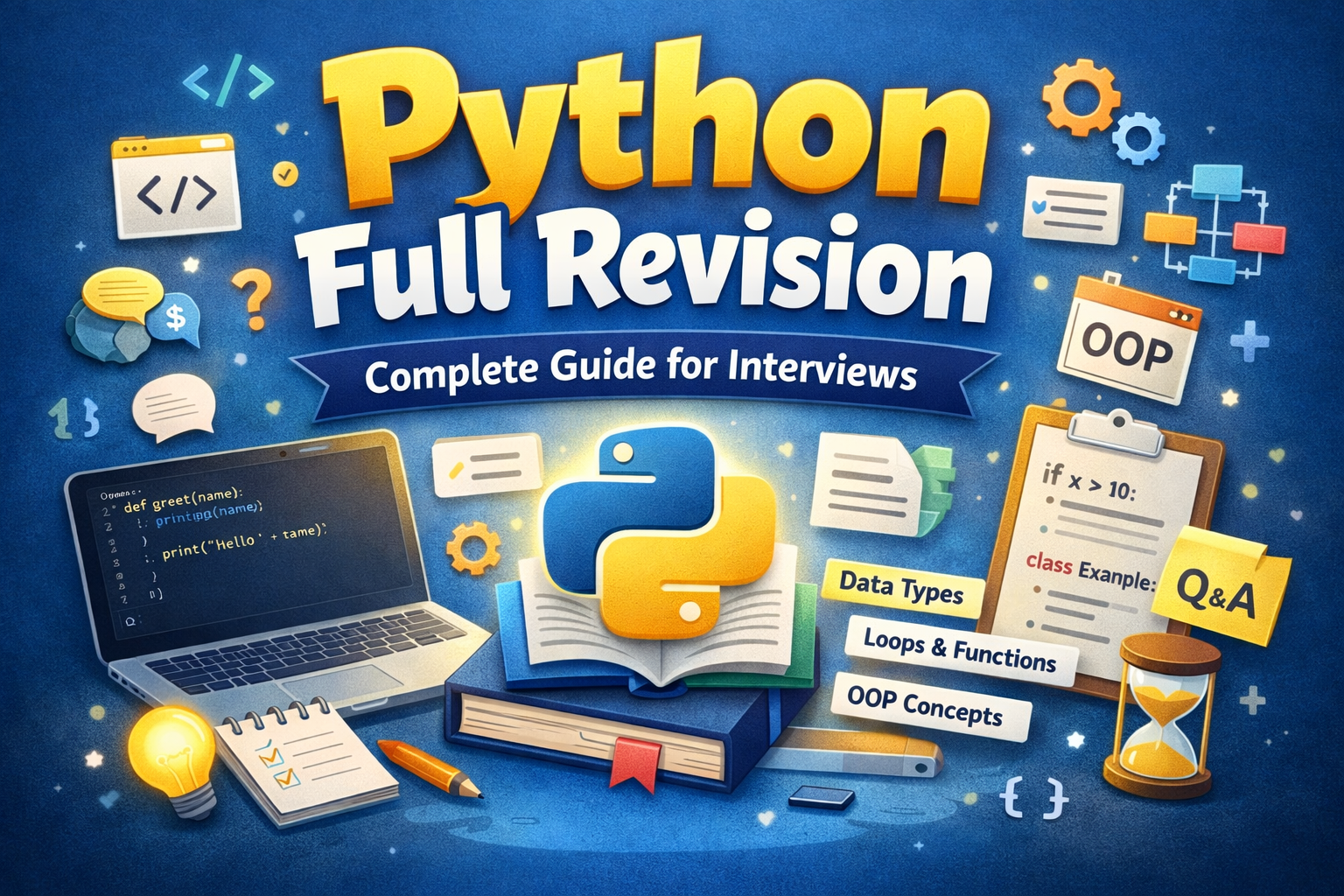
This blog explains Python programming step by step in very simple English. Each topic is explained clearly, so beginners, students, and freshers can understand easily. Best for interviews and basics.
1. What is Python?
Python is a simple and powerful programming language.
- Created by Guido van Rossum
- Easy to read and write
- Used in web development, data science, AI, automation
👉 In simple words: Python lets us talk to the computer using easy English-like words.
2. Why Learn Python?
- Very easy for beginners
- Less code compared to other languages
- High job demand
- Used in many fields
3. Python Program Structure
Python does not use {} brackets. It uses indentation (spaces).
print("Hello World")
4. Variables
Variables are used to store values.
age = 20
name = "Python"
5. Data Types
Data types tell Python what type of data we store.
| Type | Meaning |
|---|---|
| int | Whole number |
| float | Decimal |
| str | Text |
| bool | True / False |
| list | Multiple values |
6. Input and Output
name = input("Enter name: ")
print(name)
7. Operators
Operators perform operations.
- Arithmetic:
+ - * / % - Comparison:
> < == != - Logical:
and or not
8. Conditional Statements
Used to make decisions.
if age >= 18:
    print("Adult")
else:
    print("Minor")
9. Loops
Loops repeat code.
for i in range(1, 6):
    print(i)
10. Functions
Functions are blocks of code.
def greet():
    print("Hello")
OOPS Concepts in Python (Very Simple)
11. What is OOPS?
OOPS means Object-Oriented Programming System.
👉 It is a way of writing programs using classes and objects.
12. Class and Object
Class
A class is a blueprint.
Object
An object is a real thing created from a class.
class Student:
    def __init__(self, name):
        self.name = name

s1 = Student("Raj")
13. Constructor
A constructor runs automatically when an object is created.
class Test:
    def __init__(self):
        print("Constructor called")
14. Encapsulation
Encapsulation means binding data and methods together.
👉 It helps protect data.
Example:
class Person:
    def __init__(self):
        self.name = "Raj"
15. Inheritance
Inheritance allows one class to use another class properties.
👉 Child class uses parent class.
class Parent:
    def show(self):
        print("Parent class")

class Child(Parent):
    pass
16. Polymorphism
Polymorphism means one name, many forms.
👉 Same function works in different ways.
class A:
    def show(self):
        print("A")

class B(A):
    def show(self):
        print("B")
17. Abstraction
Abstraction means hiding internal details and showing only what is needed.
👉 Focus on what to do, not how.
18. Exception Handling
Used to handle errors.
try:
    a = 10/0
except:
    print("Error occurred")
19. File Handling
Used to store data permanently.
file = open("data.txt", "w")
file.write("Hello")
file.close()
20. Advantages of Python
- Easy to learn
- Less code
- Powerful libraries
21. Disadvantages of Python
- Slower than C/C++
- Not good for low-level programming
Conclusion
Python with OOPS is very powerful and beginner-friendly. It is best for learning programming, interviews, and real-world projects.
12 thoughts on “Python Programming – Quick Review (Simple & Easy Guide)”